C.J. Mahaney is the leader of the Sovereign Grace churches, an association of congregations that was born out of his pastoral ministry at Covenant Life Church in Gaithersburg, MD, and now has hundreds of churches around the world. They also created Sovereign Grace Music, a source of wonderful worship songs and hymns. I greatly appreciate C.J.'s sermons and books.
This message was the first of the T4G conference, and is a wonderful encouragement to anyone serving the Lord, but especially good for pastors--if you want an insight into our lives, listen in.
Saturday, April 14, 2012


Friday, April 13, 2012
David Platt on the Fuel for Death-Defying Missions
I want to share with you some of the messages I heard in attending Together for the Gospel (T4G) this week, and wanted to begin with this one.
David Platt's message was the finest message on missions, sovereignty, and redemption I can recall hearing. And this brother's heart bleeds for the world and for the glory of God. Give yourself time to listen and watch.
David Platt's message was the finest message on missions, sovereignty, and redemption I can recall hearing. And this brother's heart bleeds for the world and for the glory of God. Give yourself time to listen and watch.
Saturday, April 7, 2012
BIG SATURDAY QUESTION: "But, where was Jesus?"
The question comes most naturally after considering what everyone else was doing on Saturday between crucifixion and resurrection. We know His body was in the tomb, but where was His spirit?
Many versions of the Apostles' Creed say "He descended into Hell." This is not in the earliest forms of the Creed, and reflects a later understanding. Some point to 1 Peter 3:19 as saying Christ went to the spirits in prison (Hell) and preached to them. But the previous verse refers to His spirit preaching, and verse 20 says it was once in the days of Noah. Thus it is better to take this as a reference to Christ speaking through Noah's preaching back then to spirits now in prison, who died in the Flood. Technically, Hell is no person's destination until death and Hades are cast into the lake of Fire in Revelation 20. Hades, a place of torment while souls are awaiting judgment, is the destination of those who die under the condemnation of their sins.
It would also be wrong to say that Jesus completed His suffering by going to Hell, for he suffered the pains of Hell on the cross, and then announced "It is finished." He then commended His spirit into the Father's keeping, which would not be Hell.
Actually Jesus told us where He would be. He told the thief on the cross who believed, "Truly I say to you, today you will be with me in Paradise" (Luke 23:43). Paradise, also called Abraham's bosom (Luke 16:22), corresponds to Hades in that it was a temporary place, but a place of rest and refreshment awaiting final redemption and renewal. Most Christians teach that all who were in Paradise have been led by Jesus into the Father's presence to await with Him the final resurrection.
So, we don't use the phrase "He descended into Hell" when we recite the Apostles' Creed; instead, we follow the most ancient versions that leave it out. And we don't have to wonder if Jesus went to Hell after the cross. He experienced Hell on the cross so we would not have to, and then went to join the righteous dead in Paradise.
The Saturday of Jesus' Passion Week
Theme: Waiting

Text: Mark 16:1; Luke 23:56; Matt. 27:62-65

The records of what happened on the day between the crucifixion and resurrection of Jesus are brief. Nothing is reported about the disciples--we can only gather from the lack of faith demonstrated later that they were not confidently expecting Jesus' words about rising again to come to pass.
The women who wanted to care for Jesus' body ran out of time on Friday to complete their preparations: the tomb was closed while they went home and rested for the Sabbath as required by Jewish Law. Saturday night was spent getting the final supplies and preparing to go to the tomb the next day--wondering how they would move that stone.
But the enemies of Jesus were disturbed. They knew that Jesus had said He would rise. So they went to Pilate to ask for guards to be sent to the tomb to keep his disciples from stealing the tomb. Obviously these Jewish opponents of Jesus feared the power of Jesus to motivate his disciples, even if they didn't believe in resurrection.
Sometimes those who don't believe in Jesus have a clearer understanding of what Jesus words can mean than do His own disciples. Maybe that's why so many efforts are made to keep people from hearing or reading God's Word.
Thank God that the despair and dejection of that Saturday never need be faced by any of Jesus' followers again, for less than 24 hours later, Jesus would emerge from the tomb and the question of whether or not He was Messiah and His sacrifice sufficient would have been forever settled.
Friday, April 6, 2012
The Friday of Jesus' Passion Week
Text: John 18:28-38
Theme: Truth

There is so much more to be said about the day of Jesus' death than I can even mention in this format, but let me simply point out one moment. It is Jesus, standing before Pilate, questioning him and having Jesus answer with questions and hard sayings.
"Are you king of the Jews?" asks Pilate.
"Do you say this on your own, or did others say it about me?"
"Am I a Jew? Your nation has delivered you over..." Pilate responds. "What have you done?"
"My kingdom is not of this world..."
"So, you are a king!"
"For this purpose I was born," said Jesus, "to bear witness to the truth."
It is at this moment, as Ravi Zacharias first pointed out in a sermon I heard, that a huge opportunity is presented and missed.
Pilate responds to Jesus' statement by asking, "What is truth?"
But instead of waiting for Jesus to respond, he turns and goes outside.
Pilate was a skeptic, who didn't believe there was truth to guide you: there was only opportunities to be snatched or missed, and circumstances to be controlled or else have them control you.
Imagine if he had waited. At every moment in this dialog, Jesus had responded. But here, Pilate doesn't wait for a response. If he had, what would Jesus have said? Would it have mattered? It would not have changed the outcome as Christ's sacrifice was not optional, but might have begun a change in Pilate. We can never know.
On this Good Friday, many will not know what the day is about. Many others will recognize an historical event, but not seek to know the truth of what happened and why.
May your Good Friday be one where you know what happened, and why it happened, and that it happened all for you.
Thursday, April 5, 2012
The Thursday of Jesus' Passion Week
Text: John 13:1-17:26
Theme: New Commandment

Our text today is a long one, but that is because it was so important that John dedicates almost 20% of his gospel to the account of the last supper in the upper room. Why so much time here?
There were, it is true, many poignant moments. The passage begins by stressing Jesus' unfailing love for His disciples, right to the very end. And it concludes with a prayer that reflects that love. He taught them humility by washing their feet, and told them that those who know him are "clean." He explained that He was the vine and we are the branches, taught on our future dwelling in His Father's house, and He instituted the Lord's Supper. He revealed His betrayer, and He promised the Holy Spirit to us. All of this took place in the course of a supper, which the other gospels identify as a Passover meal.
But something we sometimes miss is that Jesus, having earlier this week summarized the whole Law in two commandments, now offers a third to be kept by His disciples. The two summary commandments we may remember:
Theme: New Commandment
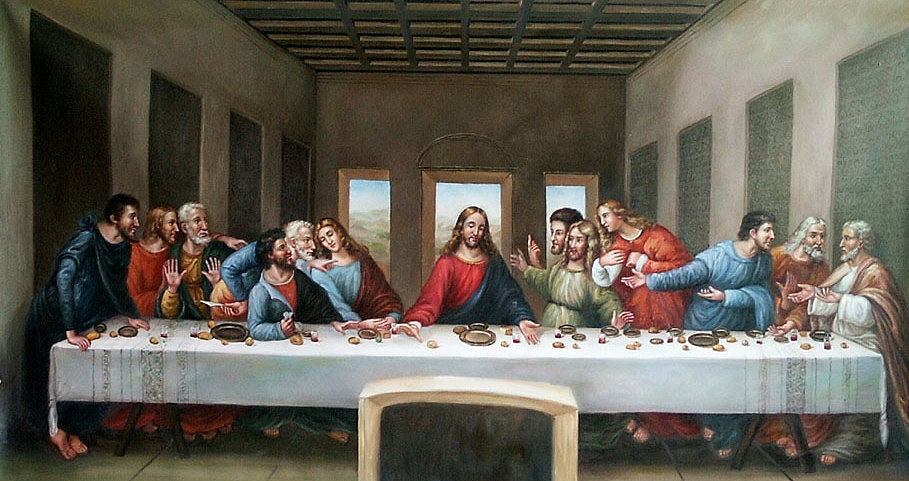
Our text today is a long one, but that is because it was so important that John dedicates almost 20% of his gospel to the account of the last supper in the upper room. Why so much time here?
There were, it is true, many poignant moments. The passage begins by stressing Jesus' unfailing love for His disciples, right to the very end. And it concludes with a prayer that reflects that love. He taught them humility by washing their feet, and told them that those who know him are "clean." He explained that He was the vine and we are the branches, taught on our future dwelling in His Father's house, and He instituted the Lord's Supper. He revealed His betrayer, and He promised the Holy Spirit to us. All of this took place in the course of a supper, which the other gospels identify as a Passover meal.
But something we sometimes miss is that Jesus, having earlier this week summarized the whole Law in two commandments, now offers a third to be kept by His disciples. The two summary commandments we may remember:
- "You shall love the Lord your God with all your heart and with all your soul and with all your mind" (Matt. 22:37)
- "You shall love your neighbor as yourself." (Matt. 22:39)
A new commandment I give to you, that you love one another: just as I have love you, you also are to love one another. By this all people will know that you are my disciples, if you have love for one another (John 13:34-35)
Who does the loving here? His disciples. And who are they to love? One another--the rest of the disciples, or what we call Christ's Body, the Church.
If we read this passage from the standpoint of Jesus' love for us and His desire for us to love each other deeply, it takes on a powerful new meaning. He washes disciples' feet because He loves us, and He wants us to wash each others' feet because we love each other. We draw life from Christ the true vine, but we share in that life together. The Spirit will come because Jesus loves us, but He comes to us, collectively, binding us together even as He binds us to Christ.
Further, if we take Jesus' three commands as the summary of what He wants us to become as His grace transforms us, it looks like this:
- We love God supremely, with everything we are and have.
- We love others humbly, putting their needs on equal footing with ours
- We love the Church sacrificially, putting our collective good ahead of individual desires
This is what Jesus modeled in the Upper Room, and even more powerfully in the Garden and on the Cross.
Pray today that we will fulfill this high and holy calling.
Wednesday, April 4, 2012
The Easter Story
This video is one of the Moi tribesman from people featured in the previous post. I love seeing this.
Subscribe to:
Posts (Atom)